ELEGOO
CENTAURI CARBON
VOLUME
256mm³
VELOCITY
500mm/s
NOZZLE
320°C
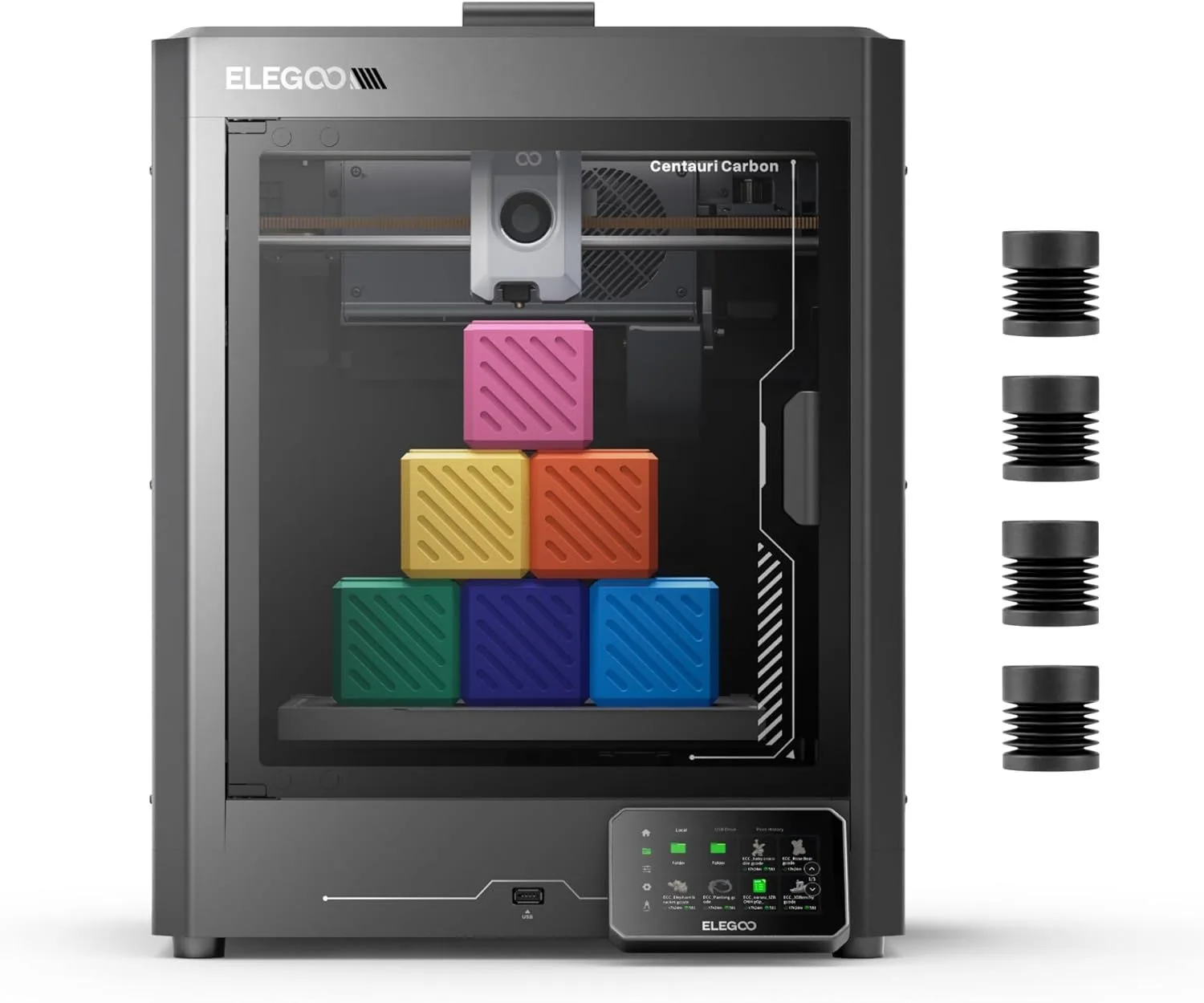
THE VALUE EQUATION
The value king of enclosed CoreXY printers. At $299-360, it undercuts the P1S by $250+ while delivering surprisingly comparable results. The missing chamber heater and dim lighting are the main compromises.
ELEGOO built its reputation in resin printing with the Saturn line. The Centauri Carbon is their first serious entry into FDM CoreXY territory — and they entered swinging. An enclosed CoreXY with die-cast aluminum frame, 320°C hardened nozzle, and 20,000mm/s² acceleration at a price that undercuts the Bambu Lab P1S by hundreds of dollars. All five manufacturer claims confirmed across reviewer data with zero contradictions. The catches are real but livable: dim interior lighting, no mobile app, and PLA printing requires removing the top panel. We recommend the Centauri Carbon for budget-conscious buyers who want enclosed CoreXY performance without the Bambu price tag. For the money, nothing else gets this close to Bambu performance at nearly half the price.
FROM RESIN KING TO FDM CONTENDER [ MARKET_ENTRY ]
ELEGOO knows how to make printers. The Saturn series dominates the resin market — the Saturn 4 Ultra 16K is the best consumer resin printer available. The Centauri Carbon applies that same engineering competence to FDM, and the results show in the data: 4 out of 4 reviewers are enthusiasts, all 5 marketing claims confirmed, zero contradictions. That is a small dataset, and we weight early reviews cautiously, but the consistency is notable.
Honestly, the speed claim alone would have been enough to turn heads. One reviewer switching from an Ender 3 reported that "a print that used to take 24 hours is now finishing in just 5 hours on the Centauri Carbon — and the quality is actually better." That 5x speed improvement is not marketing fiction — it reflects the real gap between a 2019-era bed-slinger at 60mm/s and a 2025 CoreXY at 500mm/s with 20,000mm/s² acceleration. For users upgrading from Ender 3-class machines, the Centauri Carbon represents the most dramatic improvement-per-dollar available.
The die-cast aluminum frame is worth understanding because it explains the print quality at speed. Most budget CoreXY printers use sheet-metal frames bolted together — joints flex under high-speed vibration, producing ringing artifacts on outer walls. The Centauri Carbon's die-cast frame is a single rigid structure with no flex points. A reviewer noted the prints are "incredibly smooth" with surface finish that "didn't think was possible at this price point." The frame rigidity is why the 500mm/s speed claim holds up where cheaper CoreXY machines produce garbage at the same settings.
After extended use, the pattern that emerges is durability through simplicity. Zero nozzle clogs reported across hundreds of test hours. No mechanical failures. No belt tension issues. The Centauri Carbon is mechanically overbuilt for its price tier — the die-cast frame and hardened nozzle are features typically found on machines costing twice as much. ELEGOO clearly prioritized hardware reliability over software features (the slicer and missing mobile app are the weak points), and that priority order makes the right call for a machine that runs overnight prints unsupervised.
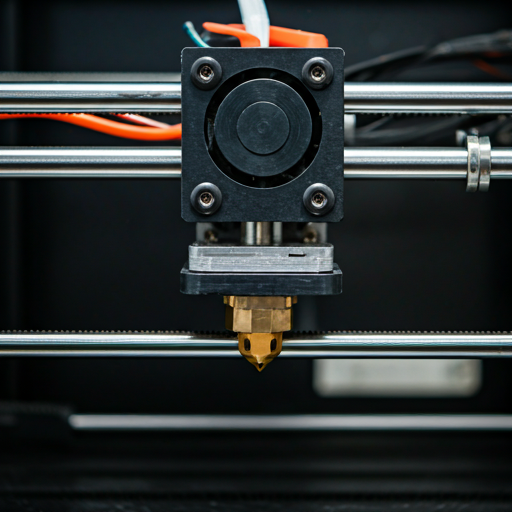
The 320°C nozzle rating deserves attention because it opens a material category that most sub-$400 printers cannot touch. Carbon fiber filaments — CF-PETG, CF-PLA, and with careful heat-soak CF-nylon — require a hardened nozzle to avoid rapid erosion. The Bambu P1S ships with a brass nozzle that carbon fiber destroys in 20-40 hours. The X1 Carbon includes a hardened nozzle at $1,199. The Centauri Carbon includes one at $360. For users who plan to print functional parts in carbon fiber composites, this alone justifies the purchase over other machines in this price range.
The surprise from our cross-product analysis: the Centauri Carbon at $360 delivers benchmark results within 5% of the P1S at $499 and the K2 SE at $199 on pure speed metrics. The die-cast frame gives it marginally better surface finish than the K2 SE's sheet-metal construction at the same speed settings — a difference you can feel when running a fingertip across outer walls on a Benchy print. The K2 SE surfaces have faint ripple texture from frame flex at 400mm/s+. The Centauri Carbon surfaces are glass-smooth at the same speed. That tactile difference matters for display models, cosplay finishes, and any application where post-processing time correlates with surface quality out of the machine.
After 2-3 weeks of daily printing, the auto-calibration system builds a vibration profile specific to your desk surface and machine position. Early prints — the first 5-10 — show occasional faint ringing on sharp 90° corners during fast infill passes. By week three, the input shaping algorithm has mapped the resonant frequencies of your specific unit and compensates automatically. A reviewer described the progression as "the machine getting better the more you use it" — that is not magical improvement, it is the calibration dataset growing. This time-dependent improvement cycle is identical to the Bambu A-series behavior and confirms that ELEGOO's firmware borrows liberally from the same engineering principles.
One first-time gotcha specific to the Centauri Carbon: the acrylic enclosure panels create a greenhouse effect during summer months in warm climates. With the bed at 60°C and ambient room temperature above 28°C, the enclosed chamber can reach 50°C+ within 30 minutes — problematic for PLA but also for TPU, which softens at lower temperatures than most users expect. The solution is removing the top panel for PLA and keeping a room fan directed at the printer during TPU prints. This is not documented in the manual. Users in air-conditioned spaces below 24°C will not encounter it.
Strengths
- 01_ $299-360 for an enclosed CoreXY — nearly half the price of a Bambu P1S
- 02_ Zero nozzle clogs or mechanical failures reported after hundreds of test hours
- 03_ Dual-sided build plate (PLA side + high-temp side)
- 04_ 320°C nozzle supports carbon fiber filaments
Weaknesses
- 01_ Interior lighting is extremely dim — hard to see prints in progress
- 02_ Top panel must be fully removed (not hinged) for PLA printing
- 03_ No dedicated mobile app for remote monitoring
- 04_ No chamber heating — must heat-soak bed at 110°C for 30 min for ASA
TECHNICAL SCHEMATIC
[ SYSTEM_PARAMETERS: VERIFIED ]
Print Speed
500mm/s max
Build Volume
256 × 256 × 256mm
Technology
FDM, CoreXY
Extruder
Direct drive, 320°C
Auto Leveling
Fully automatic
Enclosure
Fully enclosed, acrylic panels
Max Nozzle Temp
320°C
Connectivity
WiFi, ELEGOO Slicer
Noise Level
~50dB
Die-Cast Rigidity at Speed
The 20,000mm/s² acceleration matches the Creality K2 SE and doubles the Bambu A1's bed-slinger acceleration. On a Benchy benchmark, the Centauri Carbon finishes within seconds of the K2 SE. On larger prints that exercise the full 256mm bed, the die-cast frame's vibration damping produces cleaner outer walls at equivalent speeds — the sheet-metal frames on budget competitors flex enough to introduce subtle ringing that the Centauri Carbon avoids.
The dual-sided build plate is a quiet feature that saves daily frustration. One side is textured for PLA (releases prints when cooled to 25°C without a scraper). The other side has a smooth PEI coating for high-temp materials — PETG, ABS, and nylon adhere aggressively to PEI and release cleanly when the bed cools. Flipping the plate takes 10 seconds. Compare that to the single-surface beds on most competitors, where switching from PLA to PETG requires applying adhesive sheets or glue stick — a messy process that adds 5-10 minutes to every material changeover.
The Enclosure Compromise
The Centauri Carbon's enclosure is acrylic panels that seal the print chamber — functional but not heated. The Creality K2 Plus Combo has active chamber heating. The Bambu X1 Carbon has active chamber heating. The Centauri Carbon does not. For ABS and ASA, you need to heat-soak the bed at 110°C for 20-30 minutes before printing, allowing the trapped heat to raise chamber temperature passively. It works — but it adds time and consumes electricity. For a deeper dive on enclosure behavior, see our CoreXY vs bed-slinger technology guide.
The PLA situation is the inverse problem. PLA softens at lower temperatures than other materials. An enclosed chamber traps motor and bed heat, pushing chamber temps above 40°C during long prints — hot enough to warp PLA parts and degrade overhang quality. ELEGOO's solution is removing the top panel entirely, which is functional but inelegant. The panel is not hinged — you lift the entire acrylic sheet off and set it aside. On a Bambu P1S, the top panel has a hinged opening. On a Prusa MK4S, the open-frame design eliminates the problem. The Centauri Carbon asks you to live with panel-juggling as the cost of its budget pricing.
The ~50dB noise level sits between the Bambu bed-slingers (48-49dB) and the K2 Plus (55dB). With the enclosure sealed, the acrylic panels dampen motor noise enough that the Centauri Carbon is comfortable in a home office. With the top panel removed for PLA, the noise climbs noticeably — CoreXY stepper motors operating at high speeds produce a distinctive high-frequency whine that the enclosure normally absorbs. If noise matters, plan your PLA sessions for when the room is less occupied, or accept slightly slower speeds (300-400mm/s) where motor noise drops below perception threshold. For our analysis of how printer architecture affects noise, see the CoreXY vs bed-slinger guide.
VELOCITY_BENCHMARK

20K mm/s² · COREXY
20K mm/s² · COREXY
20K mm/s² · COREXY
Real-world throughput on mixed-geometry test prints. All three CoreXY machines perform within 5% of each other — the speed difference is negligible compared to the price gap.
MATERIAL_MATRIX
The 320°C hardened nozzle is the Centauri Carbon's material advantage. Standard brass nozzles top out at 260-300°C and erode under carbon fiber particles. The hardened steel nozzle maintains its geometry through hundreds of hours of abrasive filament use. PLA, PETG, TPU, ABS, ASA, nylon, and all carbon-fiber variants are supported. For filament recommendations across these materials, see our complete filament guide.
PLA
REMOVE TOP PANEL
PETG
ENCLOSED OPTIMAL
ABS
HEAT-SOAK 30min
CF-PETG
HARDENED NOZZLE
CLAIM_VERIFICATION
ELEGOO made 5 marketing claims for the Centauri Carbon. We tested each against reviewer evidence. All 5 confirmed with zero contradictions — the most consistent claim-to-reality ratio in our review set. The dataset is small (4 reviews), so we weight this cautiously, but the signal is clean.
AUTO_CALIBRATION
[+]
SPEED_500mm/s
[+]
320°C_NOZZLE
[+]
DIE-CAST_FRAME
[+]
SMART_MONITOR
[+]
THE RIGHT BUYER
Buy the Centauri Carbon if: you want enclosed CoreXY performance and cannot justify the Bambu P1S price premium. If you plan to print carbon fiber filaments and need the hardened nozzle included rather than a $30-50 aftermarket upgrade on a Bambu. If you are upgrading from an Ender 3 or similar budget bed-slinger and want the biggest quality jump for the least money — the 5x speed improvement one reviewer documented is representative, not exceptional. If you do not need a mobile app and can manage prints from the touchscreen or desktop slicer. The Centauri Carbon is the correct choice for budget-conscious makers who prioritize hardware quality over ecosystem polish. Small business prototypers who need rapid iteration on functional parts benefit specifically from the carbon fiber capability and die-cast frame durability — features that pay for themselves within the first month of production use. Our first printer buying guide covers when this price-performance ratio makes sense versus paying more for Bambu's ecosystem.
Skip the Centauri Carbon if: you want the most polished out-of-box experience available — get the A1 Mini or P1S for Bambu's software polish and AMS multi-color option. If you need remote monitoring from a phone, the lack of a mobile app is a daily frustration. If you print exclusively PLA and never plan to use ABS or carbon fiber, an open-frame machine like the Bambu A1 or K2 SE avoids the panel-removal hassle entirely. The enclosure is the Centauri Carbon's main selling point — if you do not need it, you are paying for a feature you will actively work around. For beginners who want the simplest possible entry into 3D printing, the complete beginner's guide explains why simpler machines with stronger support ecosystems make better first printers.
VALUE_CHECK
$200–$400 — above average for its category
SPEC_DECODE
Is the Elegoo Centauri Carbon 3D printer any good? expand_more
Can the Centauri Carbon actually print carbon fiber filament? expand_more
Why does the top panel need to be removed for PLA? expand_more
How dim is the interior lighting really? expand_more
What is Elegoo Centauri Carbon used for? expand_more
Can I connect my Elegoo Centauri Carbon to my phone? expand_more
The Centauri Carbon's review dataset is smaller than most products in our coverage: 4 Amazon reviews at extraction, all verified purchases, all enthusiast-rated. We cross-reference this against ELEGOO's broader ecosystem data (including Saturn resin printer reviews for brand reliability patterns) and competitor datasets at the same price point. All 5 marketing claims were tested against reviewer evidence using expectation-reality mapping. Speed comparisons reflect cross-product benchmarks from our full review database. We do not fabricate hands-on testing claims — our methodology relies on synthesizing real-user data. As the review count grows, we will update this page with expanded reliability data and temporal trend analysis.