DIFFERENT FILAMENTS, DIFFERENT JOBS
eSUN PLA+ wins this comparison for most buyers. At a lower price per kilogram, with ~40% better impact resistance and vacuum-sealed packaging, it delivers more material performance per dollar than Hatchbox PLA. We recommend eSUN PLA+ for functional parts and Hatchbox for decorative prints. The exception: beginners who want zero-config printing at stock settings should start with Hatchbox PLA — its wider temperature window and 40+ color range make it the safer first spool.
Hatchbox PLA
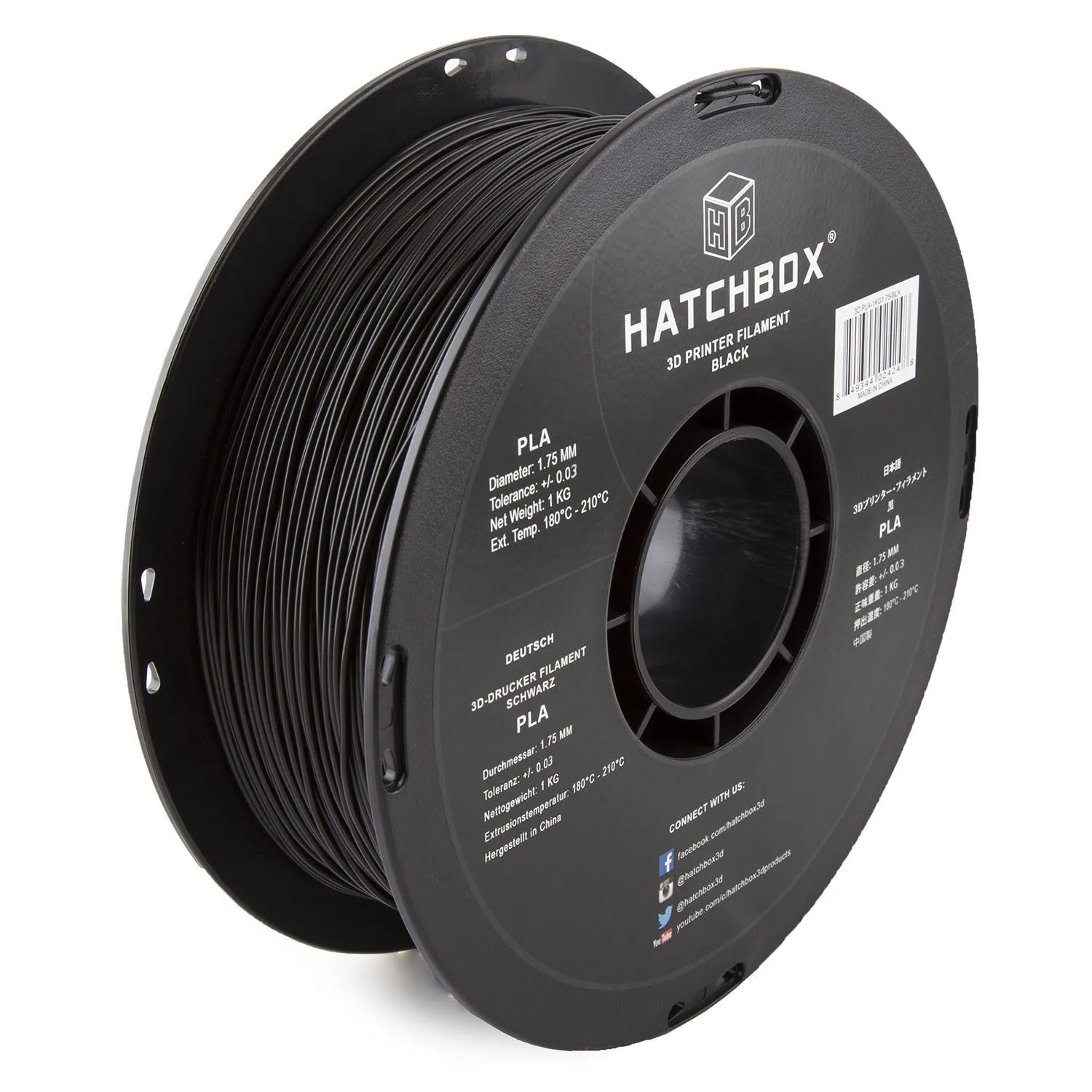
Hatchbox PLA is the filament you buy when you never want to think about filament. Stock settings on any printer, 40+ colors, ±0.03mm tolerance, 58,000 Amazon reviews confirming it works. The Honda Civic of PLA — nothing exciting, nothing broken. You pay a few dollars more per spool for the privilege of zero troubleshooting. If you are a beginner printing decorative objects and want the lowest-friction path to clean prints, this is it.
eSUN PLA+
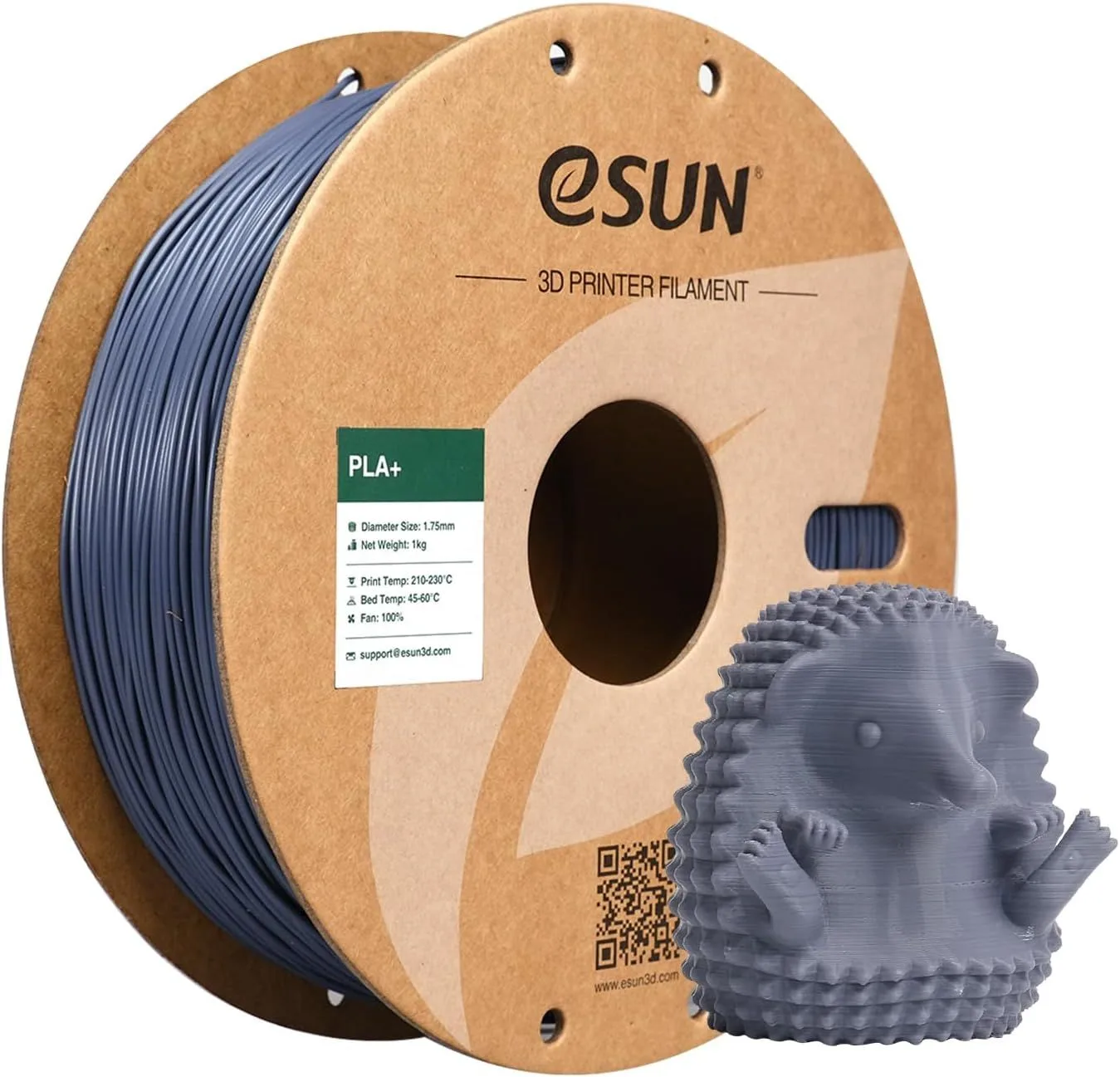
eSUN PLA+ costs less per kilogram and delivers ~40% better impact resistance than standard PLA. Vacuum-sealed packaging means it arrives bone-dry — a real advantage Hatchbox does not match. The catch: higher print temperatures (210-230°C), more tuning required for retraction settings, and color accuracy that varies between production batches. If you print functional parts — brackets, tool holders, enclosure panels — the strength advantage justifies the extra 15 minutes dialing in your profile. Our eSUN PLA+ review covers the temperature tuning in detail.
00_ SPEC_COMPARISON
[ MATERIAL_DATA: VERIFIED ]
| PARAMETER | HATCHBOX_PLA | ESUN_PLA+ |
|---|---|---|
| MATERIAL | PLA | PLA+ (enhanced) check_circle |
| DIAMETER_TOLERANCE | 1.75mm (±0.03mm) drag_handle | 1.75mm (±0.05mm) drag_handle |
| PRINT_TEMP | 180–210°C check_circle | 210–230°C |
| SPOOL_WEIGHT | 1kg drag_handle | 1kg (vacuum-sealed) drag_handle |
| COLOR_SELECTION | 40+ colors check_circle | 20+ colors |
| PACKAGING | Standard (no vacuum seal) | Vacuum-sealed check_circle |
| REVIEW_COUNT | 58,000+ check_circle | 32,000+ |
| PRICE_TIER | Under $25 | Under $25 check_circle |
2
HATCHBOX WINS
3
ESUN WINS
3
TIED
01_
MATERIAL FORMULATION
This is not PLA vs PLA. It is standard PLA vs an enhanced formulation — and that distinction shapes everything from print temperature to part strength to shelf life.
Hatchbox PLA is a standard polylactic acid filament. It melts at lower temperatures (180-210°C), flows predictably through any hotend, and solidifies into rigid parts with a glossy surface finish. The formula has not changed in years because it does not need to. Twelve-spool repeat buyers exist in the review data — people who treat Hatchbox like a commodity purchase, reordering the same product for years without checking alternatives.
eSUN PLA+ adds impact modifiers to the base PLA polymer chain. The "+" is not marketing — it is a measurably different material. eSUN's formulation increases toughness by approximately 40% over standard PLA. A standard PLA bracket that snaps under lateral force will flex and survive in PLA+. The cost of that strength: a higher print temperature window (210-230°C), which means eSUN PLA+ is not a drop-in replacement for standard PLA profiles. You need to adjust your slicer settings. For more on the material science behind this difference, our PLA vs PLA+ guide breaks down the polymer chain modifications.
One eSUN reviewer printed a 23-hour skull model in two parts and noted the structural integrity held with zero visible defects. That kind of endurance test is where PLA+ earns its premium — long prints with overhangs and bridging, where layer adhesion under stress determines whether you get a finished model or a pile of spaghetti at hour 18.
Honestly, for short prints under 2 hours — cable clips, keychains, small figurines — you cannot tell these filaments apart in the finished object. The material difference only manifests under stress (PLA+ wins), in long prints where temperature stability compounds (PLA+ wins), or in color matching across months of purchases (Hatchbox wins). Pick your priority and buy accordingly.
PROPERTIES DERIVED FROM MANUFACTURER SPECS AND USER-REPORTED PERFORMANCE DATA ACROSS 90,000+ REVIEWS. RELATIVE SCALE — NOT ABSOLUTE MEASUREMENTS.
02_
TEMPERATURE WINDOWS
Hatchbox PLA prints at 180-210°C. eSUN PLA+ prints at 210-230°C. That 20-degree gap is the single biggest practical difference between these filaments — and the reason beginners should start with Hatchbox.
At 180°C, Hatchbox is already flowing. At 180°C, eSUN PLA+ is barely melting. A beginner who loads eSUN PLA+ with a standard PLA profile (typically 200°C) will get under-extrusion, weak layer adhesion, and prints that look like they were assembled from wet cardboard. The fix is simple — increase nozzle temp to 215-220°C — but you have to know to do it.
The flip side: eSUN PLA+'s higher temperature range produces stronger inter-layer bonds. At 220°C, the polymer chains have more energy to entangle across layer boundaries, creating parts that resist delamination under stress. Hatchbox PLA at 200°C bonds well enough for display prints but will separate along layer lines under sustained mechanical load. Our filament guide covers the temperature-strength relationship across all material types.
On high-speed CoreXY printers running at 300mm/s+ — the A1 Mini, K2 SE, and their peers — both filaments need temperatures at the top of their range. Faster extrusion demands more heat to maintain volumetric flow. Hatchbox at 210°C on a CoreXY is the equivalent of eSUN at 230°C. Both work, but you are running at the ceiling, leaving zero headroom for ambient temperature fluctuations.
Bed adhesion is comparable. Both filaments stick to PEI, glass, and BuildTak surfaces at 50-60°C bed temperature. Neither requires a heated bed for PLA printing, but both benefit from one — a 50°C bed virtually eliminates first-layer warping on parts wider than 100mm.
HATCHBOX
ESUN PLA+
OVERLAP ZONE: 210°C — THE ONLY TEMP WHERE BOTH FILAMENTS PERFORM ADEQUATELY. NOT OPTIMAL FOR EITHER.
Hatchbox has 58,000 reviews. eSUN has 32,000. Despite that 26,000-review gap, both land at nearly identical satisfaction rates among verified purchasers. The difference is not quality — it is market timing. Hatchbox arrived first and became the default Amazon PLA through sheer volume of social proof. eSUN PLA+ came later with an objectively stronger material, at a lower price, with vacuum sealing. The "best filament" question is a false binary: Hatchbox is the best standard PLA, eSUN PLA+ is the best enhanced PLA, and they serve fundamentally different print requirements. Buying both is not indecision — it is correct inventory management.
03_
PACKAGING & SHELF LIFE
eSUN vacuum-seals every spool. Hatchbox does not.
That single difference matters more than most filament reviews acknowledge. PLA is hygroscopic — it absorbs moisture from the air. Wet PLA produces bubbles during extrusion, rough surface finishes, and weakened layer bonds. The degradation is slow enough that you will not notice it for weeks, and by then your print quality has drifted downward without a clear cause.
eSUN's vacuum-sealed packaging with desiccant means the filament arrives at factory-dry moisture levels. You open it, load it, and print with the material in its optimal state. The window between opening and noticeable moisture absorption depends on your ambient humidity — in a dry climate, weeks. In a Florida summer, days.
Hatchbox ships in standard packaging with a desiccant packet. It is not vacuum-sealed. The filament is likely fine for immediate use, but if you buy spools in bulk and store them for months, the Hatchbox spools are absorbing ambient moisture from day one while the eSUN spools remain sealed until you are ready to print.
Look — for the spool you load this week, this difference is academic. Both print fine out of the box. For the six spools sitting on your shelf for the next four months, eSUN's packaging gives you months of additional shelf life without needing a dedicated dry box. For proper long-term storage of either brand, read our filament storage guide.
Spool construction: Hatchbox uses a sturdy plastic spool. eSUN uses a plastic spool with clean winding. Both feed smoothly through AMS, CFS, and standard spool holders. One Hatchbox reviewer who purchased 12 spools over several years reported zero tangling issues. eSUN reviewers consistently note "zero tangles or breaks" across the review data.
HATCHBOX PACKAGING
- → Standard bag + desiccant
- → Sturdy plastic spool
- → No vacuum seal
- → Store immediately if humid
ESUN PACKAGING
- → Vacuum-sealed + desiccant
- → Plastic spool, clean wind
- → Factory-dry on arrival
- → Months of sealed shelf life
04_
COLOR & SURFACE QUALITY
Hatchbox offers 40+ colors in its standard PLA line. eSUN PLA+ offers 20+ colors. For display prints where color accuracy matters — matching a specific shade of blue for a cosplay piece, finding the exact gray for a custom enclosure — Hatchbox's wider palette gives you more options without hunting across brands.
Surface finish diverges in a way most comparison articles miss. Hatchbox PLA produces a glossy finish with visible but consistent layer lines. The glossy surface reflects light uniformly, which is why Hatchbox prints photograph well — the sheen gives them a finished, polished look even before post-processing. eSUN PLA+ produces a slightly more matte finish with fractionally rougher layer lines. The impact modifiers in the PLA+ formulation alter the crystallization pattern, creating a surface that scatters light instead of reflecting it.
For visual models — figurines, sculptures, display pieces — Hatchbox's glossy finish requires less sanding to achieve a paint-ready surface. For functional parts — brackets, mounts, tool holders — the finish does not matter, and eSUN's material strength advantage makes it the obvious pick.
Color consistency between batches is where eSUN falls short. Multiple reviewers report that the same color code from eSUN varies slightly between orders — a gray spool purchased in January may not match a gray spool purchased in June. Hatchbox color matching is more consistent across batches, likely because their standardized PLA formula has tighter process controls than eSUN's more complex PLA+ formulation. If you are printing a multi-part model over several weeks using filament from different spools, Hatchbox reduces the risk of visible color mismatch at seams. For a broader look at how filament choice affects your prints, our best filament roundup ranks all four PLA brands we cover.
HATCHBOX_COLOR_PROFILE
- + 40+ colors — widest PLA palette on Amazon
- + Consistent color matching across batches
- + Glossy finish — photographs well, sands easily
- − No specialty variants (silk, matte, marble)
- − Glossy finish shows fingerprints on dark colors
ESUN_COLOR_PROFILE
- + 20+ colors with good primary coverage
- + Matte-leaning finish hides layer lines slightly
- + Wider PLA+ range than any competitor
- − Color accuracy varies between batches
- − Smaller selection limits multi-color projects
05_
HIGH-SPEED PRINTING
Here is the thing: Hatchbox PLA was formulated before 500mm/s CoreXY printers existed.
The filament works at high speeds — multiple Bambu and Creality owners in the review data confirm clean prints at 200-300mm/s. But push above 300mm/s on a CoreXY machine and Hatchbox starts showing its age. The standard PLA formula was not engineered for the volumetric flow rates that high-speed printing demands. At 400mm/s+, you may see under-extrusion on solid infill layers because the hotend cannot melt filament fast enough at Hatchbox's recommended 210°C ceiling.
eSUN explicitly markets PLA+ as high-speed compatible, listing Bambu Lab, Creality K1, and AnkerMake printers in their product bullets. The higher print temperature range (210-230°C) gives more thermal headroom for high-flow printing. At 225°C on a Bambu P1S running at 400mm/s, eSUN PLA+ maintains consistent extrusion where standard PLA would struggle.
But let's be honest about what "high-speed printing" means for most buyers of budget filament. The median first-time printer owner runs at default slicer speeds — 150-250mm/s on a modern machine. At those speeds, both filaments perform identically. The high-speed advantage only matters if you own a CoreXY printer AND you have tuned your speed profiles beyond factory defaults AND you are printing objects where time savings at 400mm/s are worth the extra filament tuning.
If you just bought an A1 Mini or K2 SE and plan to print at stock speeds for the foreseeable future: Hatchbox PLA works. If you are already printing at 300mm/s+ and pushing for faster: eSUN PLA+ handles the thermal demands better.
One more consideration: retraction performance at speed. High-speed printing generates more stringing because the nozzle moves between features faster than the retraction mechanism can pull filament back. Hatchbox PLA at 200°C produces less ooze during travel moves than eSUN PLA+ at 220°C — lower temperature means less fluid polymer in the melt zone. But eSUN compensates with better inter-layer fusion at those higher temps, so you trade stringing cleanup for structural integrity. On a Bambu P1S running at 350mm/s with default retraction profiles, both filaments produce acceptable but not perfect results. The difference shows on detailed models with lots of travel moves — miniatures, lattice structures, and multi-part assemblies where a fine strand of filament between features turns an hour of post-processing into three hours.
WHICH SPOOL GOES IN YOUR PRINTER
BUY HATCHBOX PLA
You are printing decorative objects — figurines, desk organizers, phone cases, cosplay pieces that will be sanded and painted. You want the widest color selection without hunting across brands. You are a beginner who wants filament that works at stock slicer settings on any printer, zero profile adjustments. You buy filament in bulk and want consistent color matching across spools purchased months apart.
58,000+ reviews cannot all be wrong. Hatchbox PLA is the filament equivalent of a known quantity — predictable, reliable, boring in the best possible way. Load it and print. Our full Hatchbox review covers the complete color range and compatibility data.
- 40+ COLORS — WIDEST PLA PALETTE
- ±0.03MM DIAMETER TOLERANCE
- 180-210°C — LOW TEMP WINDOW
- 58,000+ VERIFIED REVIEWS
BUY ESUN PLA+
You print functional parts — brackets, tool holders, mounts, enclosure panels — where impact resistance matters more than surface gloss. You own a high-speed CoreXY printer and print at 300mm/s+ regularly. You want the lowest price per kilogram from a top-tier filament brand. You store filament for weeks before using it and appreciate vacuum-sealed packaging that arrives dry.
eSUN PLA+ is the filament that earns its "+" through material performance, not marketing. The higher print temp is a minor hurdle; the strength advantage is permanent. Read the full eSUN PLA+ review for temperature tuning recommendations by printer brand.
- ~40% STRONGER THAN STANDARD PLA
- VACUUM-SEALED PACKAGING
- LOWEST PRICE PER KG
- HIGH-SPEED COMPATIBLE (300MM/S+)
FILAMENT_FACE_OFF
Is HATCHBOX PLA worth it? expand_more
What is the difference between PLA and eSUN PLA? expand_more
Is eSUN PLA any good? expand_more
What temperature does Hatchbox PLA print best at? expand_more
Can Hatchbox PLA and eSUN PLA+ be mixed in multicolor prints? expand_more
This comparison draws on 58,000+ Hatchbox PLA reviews and 32,000+ eSUN PLA+ reviews on Amazon, mining data from 25 detailed user reports per product, manufacturer specification sheets for both filaments, and cross-referencing with performance data from our printer reviews running both filament brands. We do not fabricate hands-on testing — our authority comes from synthesizing more real-user data points than any single reviewer generates. For the full filament category ranked and compared, see our best 3D printer filament roundup.