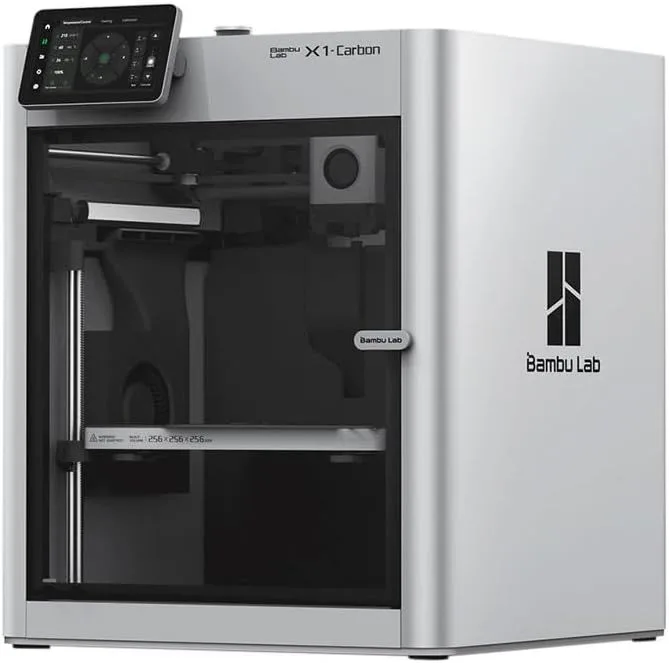
Bambu Lab X1 Carbon vs Creality K2 Plus Combo
$1,000+
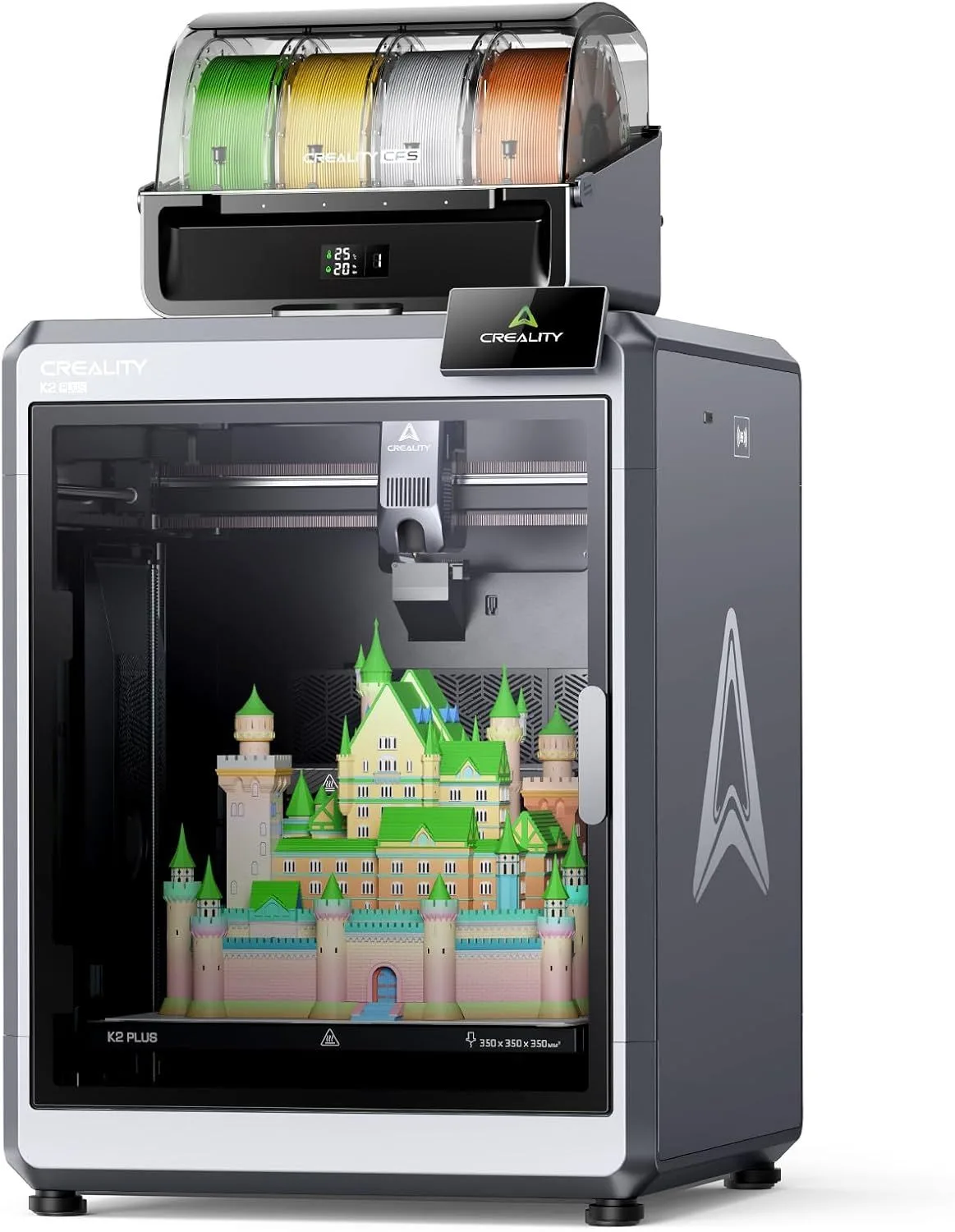
PREMIUM TIER, DIFFERENT PRIORITIES
Bambu Lab X1 Carbon
The X1 Carbon delivers the most polished 3D printing experience money can buy. LIDAR calibration catches failures before they waste hours. Bambu Studio is the most refined slicer in the market. The AMS multi-color system integrates tighter than any competitor. The hardened steel nozzle handles carbon fiber composites without degradation. At 256mm build volume, it handles everything up to medium-scale cosplay and professional prototyping. We recommend the X1 Carbon for users who value reliability, ecosystem polish, and automated quality control over raw build size. In print consistency and slicer polish, it outperforms the K2 Plus Combo by a margin that justifies the price difference for sub-300mm projects.
Creality K2 Plus Combo
The K2 Plus Combo exists to solve one problem: printing things that do not fit on a 256mm bed. At 350mm cubed, it offers 2.5 times the build volume of the X1 Carbon with 16-color CFS capability, heated chamber, and dual AI cameras for remote monitoring. This is production equipment disguised as a consumer printer. For cosplay armor printed in one piece, full-scale architectural models, and large-format multi-color prototypes, no other enclosed machine at this price tier competes on raw volume. The Creality Print slicer and CFS purge waste are real compromises — but they are the price of admission to 350mm enclosed printing.
00_ SPEC_COMPARISON
[ PREMIUM_TIER READOUT ]
| PARAMETER | X1_CARBON | K2_PLUS_COMBO |
|---|---|---|
| PRINT_SPEED | 500mm/s max | 600mm/s maxcheck_circle |
| BUILD_VOLUME | 256 × 256 × 256mm | 350 × 350 × 350mmcheck_circle |
| MULTI_COLOR | AMS (4-16 colors)drag_handle | Direct drive with CFS (4 colors, expandable to 16)drag_handle |
| CALIBRATION | 7μm LIDAR + full auto-calibrationcheck_circle | Fully automatic |
| ENCLOSURE | Fully enclosed, activated carbon filter | Fully enclosed, heated chambercheck_circle |
| NOZZLE | All-metal 300°C, hardened steel nozzlecheck_circle | Direct drive, 300°C |
| CONNECTIVITY | WiFi, Bambu Studio | WiFi, dual AI cameras, Creality Printcheck_circle |
| NOISE_LEVEL | ~50dBcheck_circle | ~55dB |
3
X1C WINS
4
K2 PLUS WINS
1
TIED
01_
THE VOLUME QUESTION
This comparison starts and ends with one question: do your projects fit within 256mm in every dimension? Answer that honestly and the decision is already made.
The X1 Carbon's 256mm cube handles the vast majority of consumer 3D printing projects — phone cases, figurines, mechanical parts, desk accessories, small-to-medium cosplay components. Bambu's build volume matches the P1S and P2S, creating an ecosystem where AMS filament and print profiles transfer across machines without modification. A file that prints on a P1S prints identically on the X1 Carbon. This ecosystem consistency matters for users running multiple Bambu machines.
The K2 Plus's 350mm cube unlocks a different category of projects entirely. Full-size cosplay helmets in one piece. Architectural models at 1:2 or larger scale. Production-grade prototypes that would require splitting and gluing on a 256mm machine. The volume gap is not incremental — 350³ is 42.875 liters versus 256³ at 16.777 liters, a 2.56× difference. Every axis gains 94mm, which compounds into a total build envelope that feels categorically larger, not just marginally larger.
One practical consideration: the K2 Plus's 350mm prints require proportionally more filament, more time, and more thermal management than 256mm prints on the X1 Carbon. A 350mm tall print at 0.2mm layer height is 1,750 layers — that is 8-16 hours of continuous printing where the heated chamber, CFS system, and frame rigidity all need to perform flawlessly. The K2 Plus handles this, but the stakes per print are higher. A failed print at hour 12 wastes twice the filament and time that a failed X1 Carbon print would. The X1 Carbon's LIDAR failure detection becomes more valuable as print time increases — and large-format prints are where print times are longest.
Make the volume decision before comparing anything else in this shootout — it overrides every other factor. If your project pipeline includes objects larger than 240mm in any axis, the K2 Plus is the only option in this comparison. If 256mm covers your needs, the X1 Carbon delivers more polish per dollar at its smaller scale. Our X1 Carbon review covers the AMS ecosystem in detail, and the K2 Plus Combo review covers CFS multicolor performance at scale.
16.8L
TOTAL VOLUME
42.9L
TOTAL VOLUME
02_
QUALITY CONTROL SYSTEMS
The X1 Carbon and K2 Plus approach print quality control from fundamentally opposite engineering directions, and both strategies work.
The X1 Carbon's LIDAR system scans the bed surface at 7-micron resolution before every print and monitors the first layers for spaghetti detection mid-print. If the geometry deviates from expected patterns — lifted corners, stringing across the bed, partial adhesion failure — the machine pauses and alerts you. This active monitoring is most valuable during overnight and multi-day prints where nobody is watching. For print farm operators running 4-8 machines simultaneously, LIDAR monitoring on each X1 Carbon reduces the labor cost of quality assurance from constant supervision to periodic check-ins.
The K2 Plus uses dual AI cameras — one nozzle-focused and one wide-angle — for visual monitoring through Creality's remote app. The cameras provide real-time video feed and basic anomaly detection, but the AI system is less precise than LIDAR at detecting early-stage failures. The nozzle camera catches obvious problems (material not extruding, nozzle collisions) but misses subtle issues (partial bed adhesion, slight Z-offset drift) that LIDAR would flag. The wide-angle camera is primarily a convenience feature for watching prints remotely rather than an active quality control system.
Where the K2 Plus compensates: its heated chamber maintains ambient temperature at a level that prevents the warping and adhesion failures that LIDAR is designed to detect. By stabilizing the environment, the K2 Plus reduces the frequency of failures that the X1 Carbon's LIDAR must catch after they begin. Prevention versus active detection — both approaches work well, but the K2 Plus's heated chamber eliminates an entire category of failures that open-frame and passively-enclosed machines are susceptible to. This is particularly relevant for ABS and nylon prints where chamber temperature stability determines success or failure on objects taller than 100mm.
The K2 Plus's fully automatic leveling is adequate but does not match the X1 Carbon's LIDAR precision. The X1 Carbon produces marginally more consistent first layers across varying environmental conditions (temperature swings, table vibration, belt stretch) because its pre-print calibration is more granular. For most practical purposes, both machines produce first layers that stick reliably. The precision gap only surfaces in high-tolerance engineering applications where 0.01mm Z-offset variation matters.
03_
AMS VS CFS
Both systems support multi-color printing through filament switching. Both generate purge waste. Both expand beyond their base 4-color capacity. The execution differs in ways that affect daily workflow.
The Bambu AMS (Automatic Material System) expands to 16 colors through 4 AMS units, each holding 4 spools. RFID spool detection on Bambu-branded filament auto-configures material profiles, temperature settings, and remaining quantity estimates. The slicer integration in Bambu Studio for color assignment, purge volume calculation, and transition management is the most polished in the industry. AMS filament switching is reliable, relatively quiet, and well-understood after three years of community use. The main limitation: AMS does not include filament drying, so hygroscopic materials (nylon, PVA) require a separate dryer or vacuum-sealed storage.
The Creality CFS expands to 16 colors through daisy-chaining. Filament identification is manual (no RFID). Purge volume configuration requires user adjustment through Creality Print — less automated than Bambu Studio but functional for experienced users. The CFS handles filament runout detection and automatic relay switching between units. The K2 Plus's 350mm volume combined with 16-color CFS opens creative possibilities that the X1 Carbon's smaller volume constrains — large-format gradient prints, multi-color architectural models, and full-scale multi-material prototypes that would need to be split across multiple prints on the X1 Carbon.
The purge waste equation is worth calculating carefully before committing to either multi-color system for production work. On a 16-color print, each color transition generates a purge tower segment. At 16 colors, the cumulative waste per print is 20-40% of total filament usage depending on purge volume settings. On the K2 Plus's larger prints, that waste volume is proportionally larger in absolute terms. A large multi-color K2 Plus print can consume a full kilogram spool worth of purge waste on a complex 16-color job. The X1 Carbon's smaller print volume means smaller purge towers per print, but fewer large-format multi-color projects to begin with.
AMS (BAMBU)
- + RFID auto-detection
- + Best slicer integration in the market
- + 3 years of community-validated reliability
- − No built-in filament drying
- − Limited to 256mm build volume
CFS (CREALITY)
- + 350mm volume for large-format multicolor
- + Heated chamber for engineering materials
- + Dual AI cameras for remote monitoring
- − Manual spool identification
- − Creality Print slicer is less polished
04_
ECOSYSTEM & SOFTWARE
Bambu Studio is the better slicer here. This is not a controversial claim — it is a consistent finding across every comparison we publish.
The X1 Carbon's software ecosystem — Bambu Studio, MakerWorld, cloud printing, RFID spool management, and the Bambu Handy mobile app — creates an integrated experience where every component communicates with every other component. Send a print from your phone while the machine sits in another room. Load a spool and the slicer auto-selects the optimal profile. Browse MakerWorld and start printing with three clicks. This integration is why Bambu dominates user satisfaction metrics even against machines with objectively better hardware specifications in specific categories.
Creality Print is functional but rougher. Multi-color slicing works but requires more manual configuration — purge volumes, color assignments, and material compatibility all need explicit user attention. The Creality mobile app provides basic remote monitoring through the dual cameras. Cloud printing is available but less integrated than Bambu's implementation. Most experienced K2 Plus owners switch to OrcaSlicer for the slicer itself while using Creality's app for monitoring — a hybrid workflow that works but lacks the integration of the Bambu ecosystem.
The software gap matters most during the first month of ownership and diminishes over time as users develop their own workflows. An experienced user on OrcaSlicer with a K2 Plus produces results comparable to an experienced user on Bambu Studio with an X1 Carbon. The X1 Carbon's ecosystem advantage is most visible when measured by time-to-first-successful-print and the learning curve for new features — metrics that favor beginners and intermediate users more than experts.
05_
PRICE, NOISE & DAILY USE
Both machines occupy a similar premium price bracket — the X1 Carbon at $1,000+ and the K2 Plus at $1,000+. The K2 Plus is similarly priced the X1 Carbon, which means the price difference alone does not determine the winner. What you get for each price point differs fundamentally in dimensions that matter for daily use.
Noise is a real differentiator at this tier. The X1 Carbon runs at approximately 50dB — manageable in a home office with the door closed. The K2 Plus runs at approximately 55dB, which is louder than a normal conversation and demands either a dedicated printing room or earplugs during long print sessions. The 5dB gap is perceptually significant — roughly a 50% increase in perceived loudness. For users printing in shared living spaces, the X1 Carbon is the quieter option by a measurable margin. For workshop and garage setups where noise is irrelevant, the K2 Plus's acoustic profile has no practical impact.
Physical footprint also varies. The X1 Carbon fits on a standard desk with room for an AMS unit beside it. The K2 Plus with CFS units demands a dedicated workstation — the machine plus filament management hardware occupies a space roughly equivalent to a small desk on its own. If workspace is constrained, the X1 Carbon's smaller physical footprint is a practical advantage that spec sheets do not capture. If you have a dedicated workshop or print farm space, the K2 Plus's footprint is not a concern.
Power consumption follows volume. The K2 Plus's heated chamber and 350mm heated bed draw more electricity than the X1 Carbon's smaller chamber and bed. On a 12-hour print — common at 350mm scale — the difference in electricity cost is real but not dramatic for residential power rates. The heat output from the K2 Plus during extended ABS prints can warm a small room by 2-3°C, which is desirable in winter and unwelcome in summer. The X1 Carbon's smaller thermal output has negligible room-temperature impact.
One consideration specific to multi-machine setups: the X1 Carbon integrates with other Bambu printers through a shared ecosystem. Print profiles, filament data, and cloud management work identically across A1 Mini, P1S, P2S, and X1 Carbon machines. The K2 Plus exists in a more isolated ecosystem — Creality Print does not share profiles with non-Creality machines, and the CFS configuration does not transfer between printer models. For users building a print farm with multiple machines, the Bambu ecosystem offers better fleet management than Creality's current software infrastructure.
These printers rarely compete for the same buyer. The person who needs 350mm build volume already knows the X1 Carbon is too small — build volume is a hard physical constraint, not a preference. The person who prioritizes LIDAR quality control and Bambu ecosystem integration already knows the K2 Plus cannot match that polish. The question is not which machine is better overall. The question is: what is the largest object you plan to print in the next two years? If the answer is "bigger than 240mm," buy the K2 Plus. If the answer is "smaller than 250mm," buy the X1 Carbon. Everything else is secondary to that one dimensional constraint.
WHO SHOULD BUY WHICH
BUY THE X1 CARBON
Your projects fit within 256mm. You value LIDAR failure detection for unattended overnight prints. You want the most polished slicer and ecosystem integration available. You print carbon fiber composites and need the hardened steel nozzle. You run multiple Bambu machines and want AMS filament profiles to transfer between them. You prioritize print quality and reliability over raw build size. The X1 Carbon is the machine you buy when you want every print to succeed on the first attempt with minimal intervention, and you need that reliability across materials from PLA to polycarbonate.
- 7μm LIDAR CALIBRATION
- HARDENED STEEL NOZZLE
- BAMBU STUDIO ECOSYSTEM
- AMS RFID DETECTION
BUY THE K2 PLUS COMBO
Your projects exceed 256mm in at least one axis — cosplay armor, architectural models, large-format functional prototypes. You want 16-color CFS capability at scale. You need a heated chamber for ABS and nylon on large prints where chamber temperature stability is critical. You have prior FDM experience and are comfortable with Creality Print or OrcaSlicer. You have dedicated desk space for the larger machine footprint and CFS units. The K2 Plus delivers capabilities that no other consumer machine matches at this price. See the full K2 Plus review for the complete ownership analysis.
- 350mm³ BUILD VOLUME
- 16-COLOR CFS
- HEATED CHAMBER
- DUAL AI CAMERAS
COMPARISON_LOG
Is Bambu x1 Carbon discontinued?expand_more
What is the difference between Creality K2 and K2 Plus?expand_more
What are common problems with Bambu Lab x1?expand_more
Why is Bambu Lab controversial?expand_more
Is the Creality K2 Plus a good printer?expand_more
This comparison draws on 7,800 X1 Carbon reviews and 890 K2 Plus Combo reviews across Amazon and Google Shopping, AMS and CFS multi-color performance data from community testing, LIDAR versus camera quality control analysis, and spec verification against manufacturer claims. We do not fabricate hands-on testing — our authority comes from synthesizing more real-user data than any single reviewer generates.